1 JANUARY 2025

A pair of Eastern bluebirds were spotted along the C&O Canal three days ago. I didn’t expect to see those this far into winter but I have since read that the population is not entirely migratory; many individuals stay in their breeding territory year round. This morning, when I opened the living room curtains, there were four bluebirds at and under the bird-feeders at the front porch. Another pair — seemingly larger than the original four — arrived at the suet feeder about two cups of coffee later.


I stumbled on to Pieter Bruegel the Elder a week or two ago, a European artist living in the time just after Martin Luther published his Ninety-five Theses. The scenes in his work are very often the people and the landscapes around him — not the wealthy and powerful. Although he engaged in commissioned and religious work, his overall body of work seems to represent a democratic shift in who was allowed to be the subject of artistic works. As far as I can tell, his winter scenes seem to be the ones that resonate with the largest audiences, although I prefer scenes like The Fall of the Rebel Angels:

Pieter Bruegel the Elder, 1562. Oil on Oak.

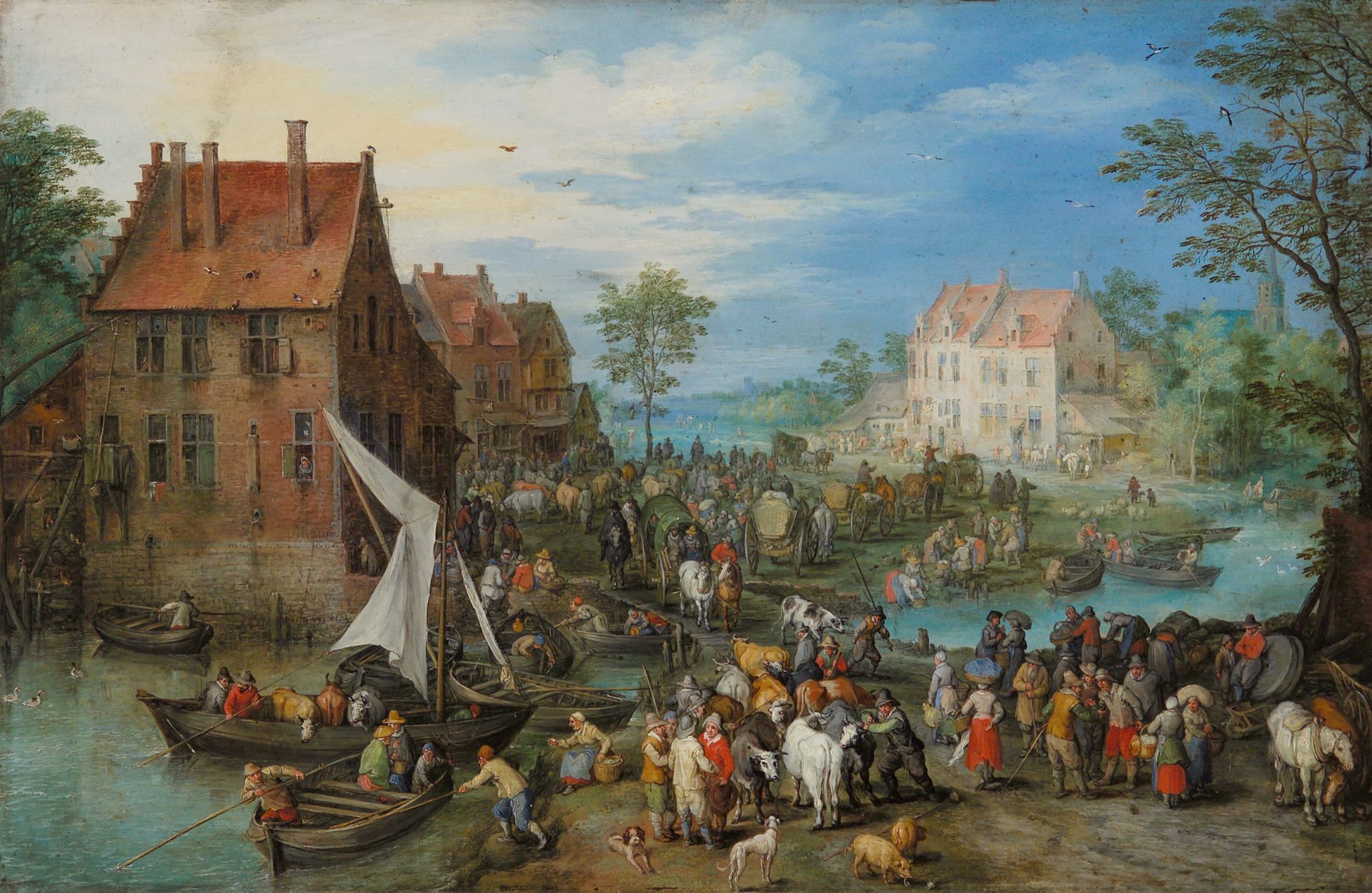
Coincidentally, his son, Jan BruegeI created a painting titled The Flemish Fair, which was made into a ‘Fine Art Jigsaw Puzzle’ that currently sits on one of our bookshelves. SEEB has had this puzzle since before we met 13+ years ago. The Bruegels have been with us this whole time.


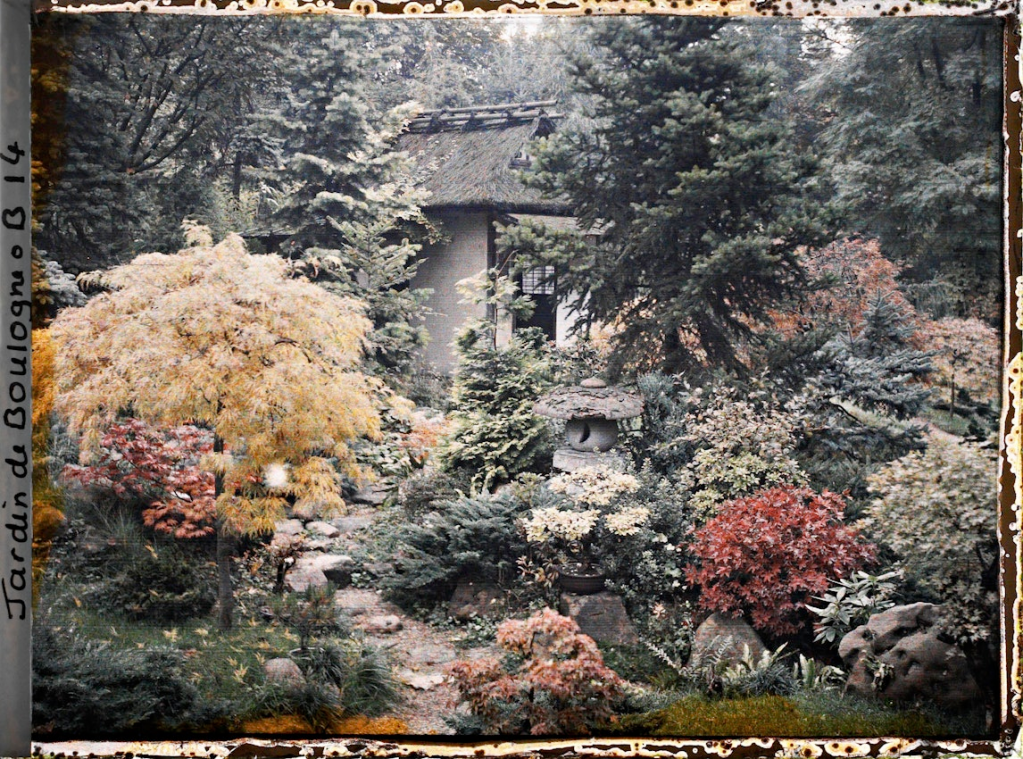
a ‘Japanese Tea Garden’ in Boulogne-Billancourt, France. 1910.

Unrelated, the photograph above is an early color photograph (an autochrome, specifically) from the collection of Albert Kahn. I post it as an example of both garden design I like and a photographic aesthetic I would like to pursue with the Polaroid received for Christmas this year.

Saturday, 05Oct24

Spent some time on a relatively untraveled stretch of Maryland’s Gunpowder river; my first time there and covering 2 miles of water (6-7 hours) I only saw one other angler. He had come in from a different point, aiming to cover some of the same water — just from the opposite bank and he started a little later in the day. Most of the banks on this stretch were about 6 feet above the water line but there were periodic egress points through the vegetation to begin reasonable approaches to the water. Most of these, however, resulted in slipping on the slick mud and unintentionally sliding down the bank into the water. Success quickly became doing so without making noise on the water or making much of a wake. I did okay after that first one.

I was looking for Brown Trout. Mostly, I caught Fall fish on the day. I had never seen Fall fish before; they are a new species for me. They ranged from 8 -12 inches and seemed to really stack up in places. In one run, I pulled at least four from the same 20 foot stretch despite the commotion and splashing made by the previous fish. I imagine there were quite a good number more in there, but eventually the spot turned off and I moved on. They (rightfully) fight hard enough, but 6x fluorocarbon is too much for them and they’re quickly to net. They seem to jump more than brown trout, not nearly as much as the wild rainbows back west — even in the net however, it takes a while for the Fall fish to settle down it seems.

These fish can sometimes reach lengths of 20″, but typically are much smaller. Larger fish of the species are called ‘Shenandoah Tarpon’ – but mainly, folks dismissively call them ‘chubs’ (a moniker they share with the similar-looking Dace of the area). Fall fish happen to be the largest native minnows found on the East Coast of the United States, for what that is worth.. [… and having gone down that rabbit-hole, I will also volunteer that the Colorado Pikeminnow is the largest native minnow in the US (up to 6 feet long and 40 lbs) adding further, that the Siamese Giant Carp of Indochina is the largest minnow, period — one being recorded in 1994 at 6ft and 330 lbs.]

The Fall fish in the picture above was simply notable for its winning personality. They photograph well — silvery bodies with darker tops to blend in with the river bottom — and those beautifully large and pronounced scales, of course. The tarpon reference is well-informed, if only for aesthetic qualities and not size or the ability to mangle and ultimately break a young man’s 3|0 hook or spool you while you’re running down the beach on the wrong side of the surf. It is a good looking fish to my eye. The fish in this photo went for an olive quill-body perdigon, tight-line drifted across the bottom of the river (just before the swing started as I recall) and after calming down, was sent back on his way, perhaps a little-bit wiser.

Earlier in the day, the high point of the day occurred while standing on the river bank peeking out through a double-door size opening in the vegetation and trees, staring at the water — trying to read what was happening in the river. A bald eagle flew from upstream, seemingly oblivious to me until it was about 6 feet from me, maybe a foot higher than eye-level. He swung his head right, noticing me right as he passed, and then did a solid bank to his left to get some distance, turning back upstream, looking at me again, and then started climbing back up (to safety?) reaching what I imagine is one of his usual perches in the largest bare White Oak that lords over the entire area. No nest observed, but he stayed there for the next twenty or thirty minutes while I worked through a nice little run from the other side of the river — until I looked up at some point and noticed him gone. I have never been so close to an Eagle as that moment, and I like the idea that we were sharing that stretch of river, each of us looking for fish in our own ways for a nice little stretch of time.

I will also note that when I arrived (still well ahead of sunrise) the first spot I entered on the river brought out a grumpy beaver who swam out, not quite half-way across the river, and started in on the tail slapping threat-displays. I am increasingly annoyed by those guys, but respect that they belong in the ecosystem. The thought of getting into it with a beaver is kind of ridiculous though — if you lose that, then you have to explain that your injuries are from a beaver — and it you win that fight, congratulations you beat up a beaver, a fact that will literally impress no one. To boot, I have to imagine that tail-thumping warns the fish that predators are about.

Best to just move on.

Finally, summer is officially over. The days are colder and the nights start sooner. Leaves are on and in the water. There is not enough light after work to make it worth driving out to the Potomac (which has been high and brown over the last couple of weeks), and unless I decide to start mousing or night-fishing, consider the Potomac back in the category of being accessible only on weekends. I feel good about my connection to the Potomac though — that I’ve learned at least a solid few miles of it really well this year– and that I know more about its changing character through the seasons, an aim I’ve been working on this year. It is a good river, and I never cease to be amazed at how completely alone you can be when you’re in it, smack dab in this middle of a metro area of millions.

currently reading: Playground, Richard Powers

Last full listen: Trail of Flowers by Sierra Ferrell

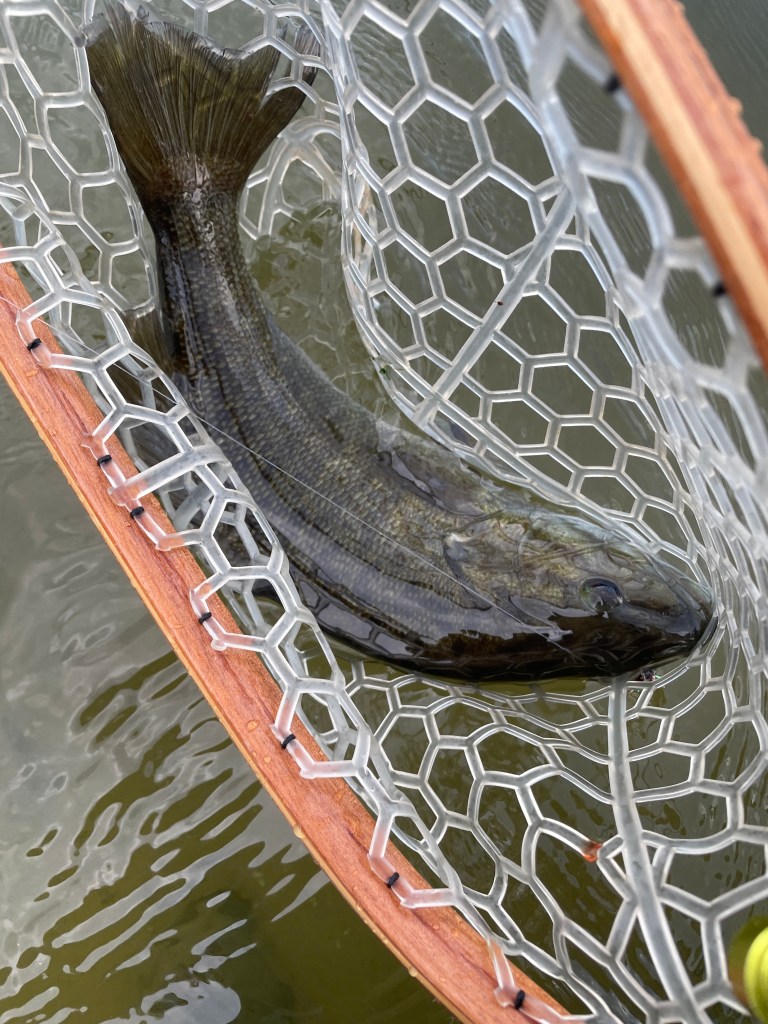
First Potomac Smallie:

After more than a few trips to the Potomac to catch a smallie on the fly, I was able to land my first two today. I’ve caught many species of fish to date, but this was my first Smallmouth Bass, a fish I’ve been after for a while — with not much success to date.

A 0X leader was able to make short work of getting the fish to the net, but there were a few attempts at runs by the bass. I image if I’d been on my 5 weight with something like a 3x leader, it might have been dicey & prolonged. An 8wt rod w/ 0X Trout Leader landed him pretty quickly for the photo & hook removal, and homeboy was on his way shortly thereafter.

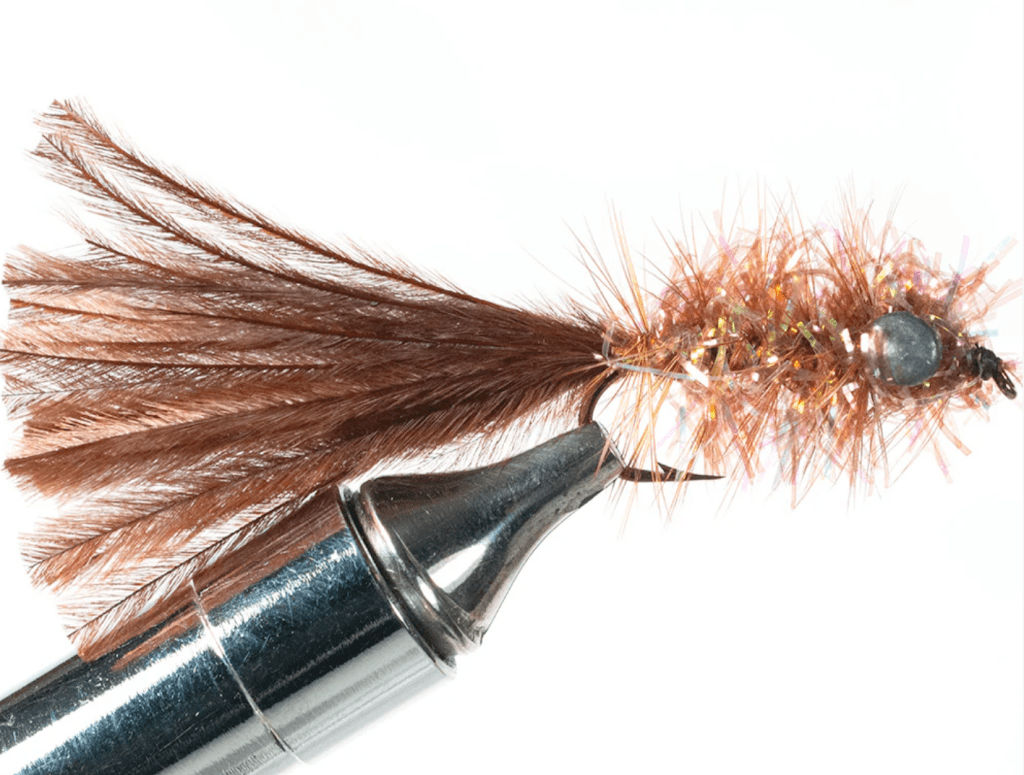
I caught him on a Murray’s Marauder I bought from Harry Murray in Edinburg, VA after landing my first Brook Trout on a trip in the Shenandoah one morning last June — and for whatever reason, decided to finally fish it tonight instead of the many other patterns I’d tied for this water. Aesthetically, the fly was just not my cup of tea, but after tonight it’s growing on me.

I generally prefer natural materials and I don’t believe I’ve ever fished a fly made w/ Estaz before. I know I haven’t used Ostrich hurl before, either. Its an interesting use of materials — and clearly effective. I will no doubt continue with my deer hair & hackle, but am likely to come around on these materials as well.

Memorializing the phenomena: I cast upstream at a very slight angle, the fly sank for about five seconds before the slack was pulled out of the line and before the current had pulled the fly downstream of the casting position, a fish was on. (Seemed to take it on the sink.) Two strip sets in quick succession confirmed and the fish alternated between swimming toward and away from me.

The second fish was caught on a downstream cast, stripping back through the ‘swing.’ That fish, about half the size of the first, took the fly on the retrieve.

Hulking the fish to the net made me wonder if this is the more humane approach. With some time to think about it, I think it is. On lighter tippets with larger trout, it seems like there’s more of a ‘conversation’ where the fish delays and exerts more effort…running back into currents, heading for cut banks, etc., both of us believing that the outcome is less certain. The goal is to land the fish and release it; reducing the duration of the fight–as fun as it can be sometimes–seems best.

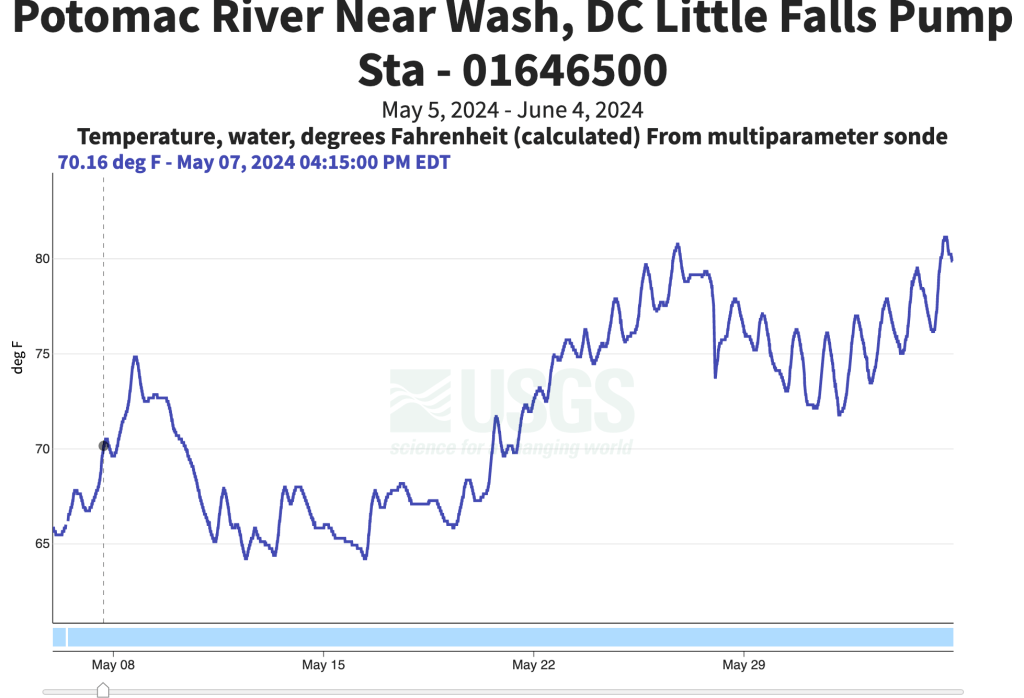
Notes on spawning season for the species: Temperatures have been above 70’F on average, since May 1st and is a large reason why I decided fishing today would be ethical. Temps first reached 58’F on April 11th. I believe the spawning season to be over at this point, but will continue to avoid fishing gravel beds anyway, opting for faster/deeper water, until the 15th, in case there are a few late spawners still guarding their fry. (noting that I saw none today while wading.)

Fishing the Potomac is impossible.

The whole thing is too big; you can only fish small sections of it at a time.

Less than ideal conditions with a storm moving in, but visited the confluence of the Monocacy and the Potomac this morning. Earned the zero after about four hours of fishing. The strategy was simply to cover water, swinging streamers. And I did that. In a less than ideal way in retrospect. Learned today that having particular features–riffles, pools, channels, etc.–allows me to easily work a specific piece of water. After a while of standing in flat, featureless water a quarter- to half-mile wide for an hour, my technique was probably just as likely to foul-hook a fish as to induce a strike.

The primary goals were to (a) hook up with smallmouth (b) work on casting – specifically, bending the rod down into the cork and paying attention to loop formation. On the latter, I realized that choking down on the handle allows the rod to bend more. Seems obvious in hindsight; odd that I never read that anywhere. I also need to pare back on the size of my streamers. There was no real reason to fish a size 4 Clouser Minnow other than that was the size I tied them. A size 8 or 10 would suffice.

The stretch of the Potomac there at the confluence is relatively featureless. 3 – 4 foot gravel bottom flats extend about 50-100 ft from shore and make it highly wade-able. That said, I am not eager to try the area again soon, or at least not during the mornings, when the water is the coolest. I would expect that fishing at last light would have the fish much more active.

I found a different place north of Point of Rocks that I liked much better. The rain had come in by then and the weather was absolutely lousy, plus it was later in the day & I had other things to do back home. The water was full of features: runs, riffles, seams, the works. I snagged often on a floating line and weighted streamers; I suspect that unweighted streamers on an Intermediate sink tip is just the ticket for the area. I plan to go back on an afternoon sometime when the water is above 70’F.

The day before Easter

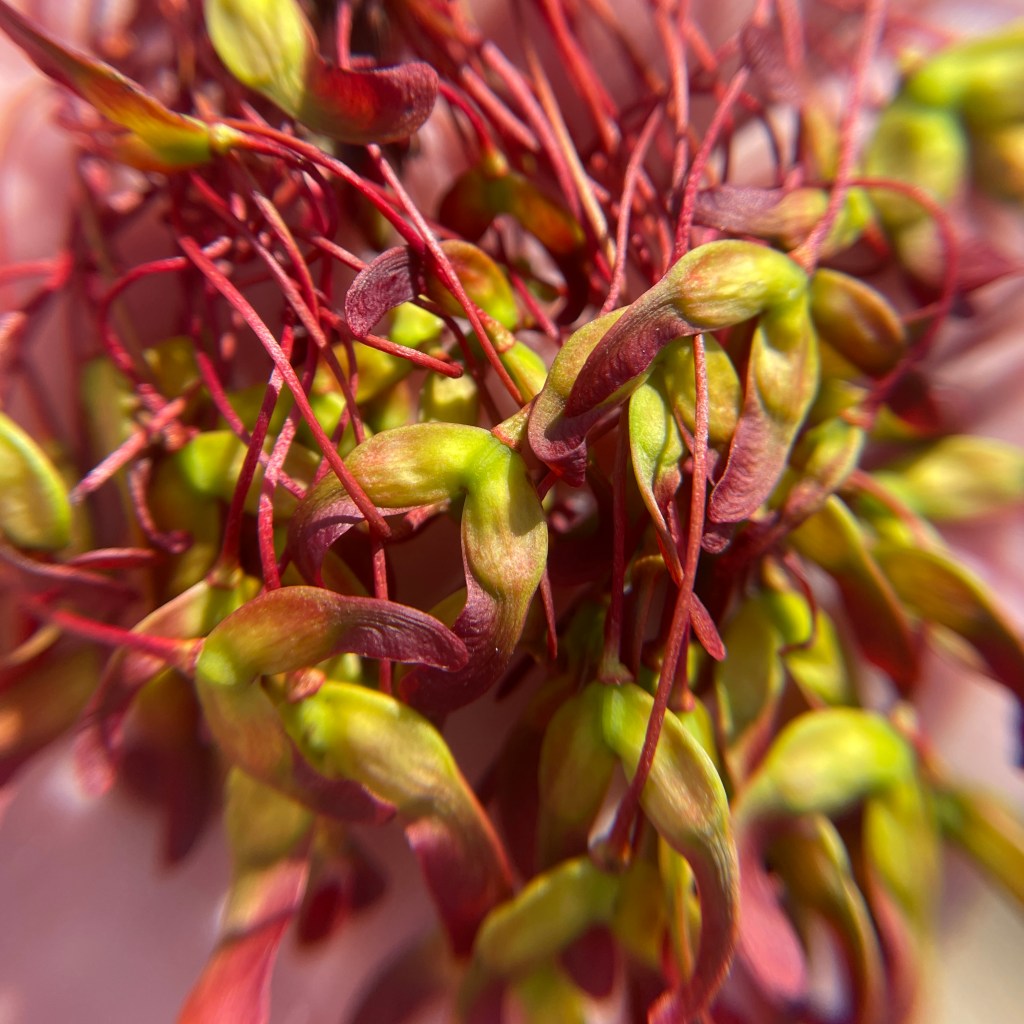
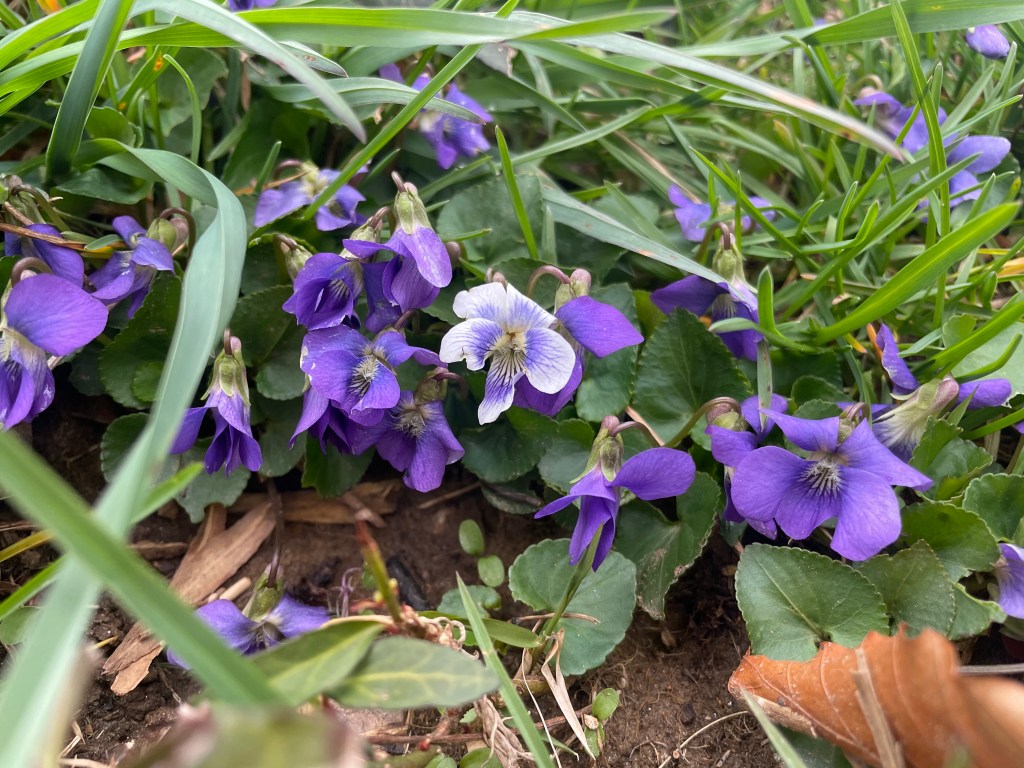
Two weeks ago I thought winter might have been over and as soon as I said it out loud it started to get colder again. Things are warming up now though and so far Spring looks something like:

I associate these with Maples but I don’t know if they’re mutually exclusive or not. Until the leaves come in, Red Maple is now my best guess for our ‘Street tree’ out front.

Flora in bloom:

Unidentified flowers in back yard

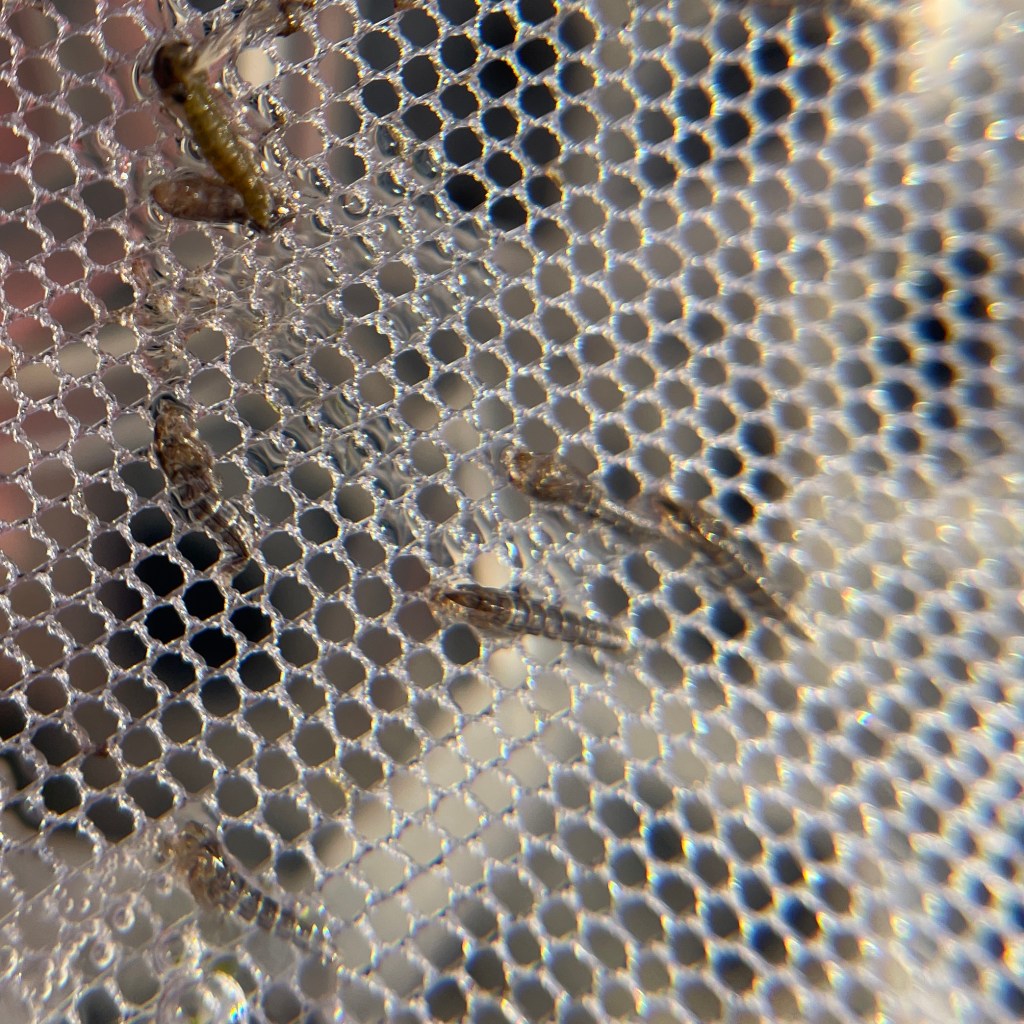
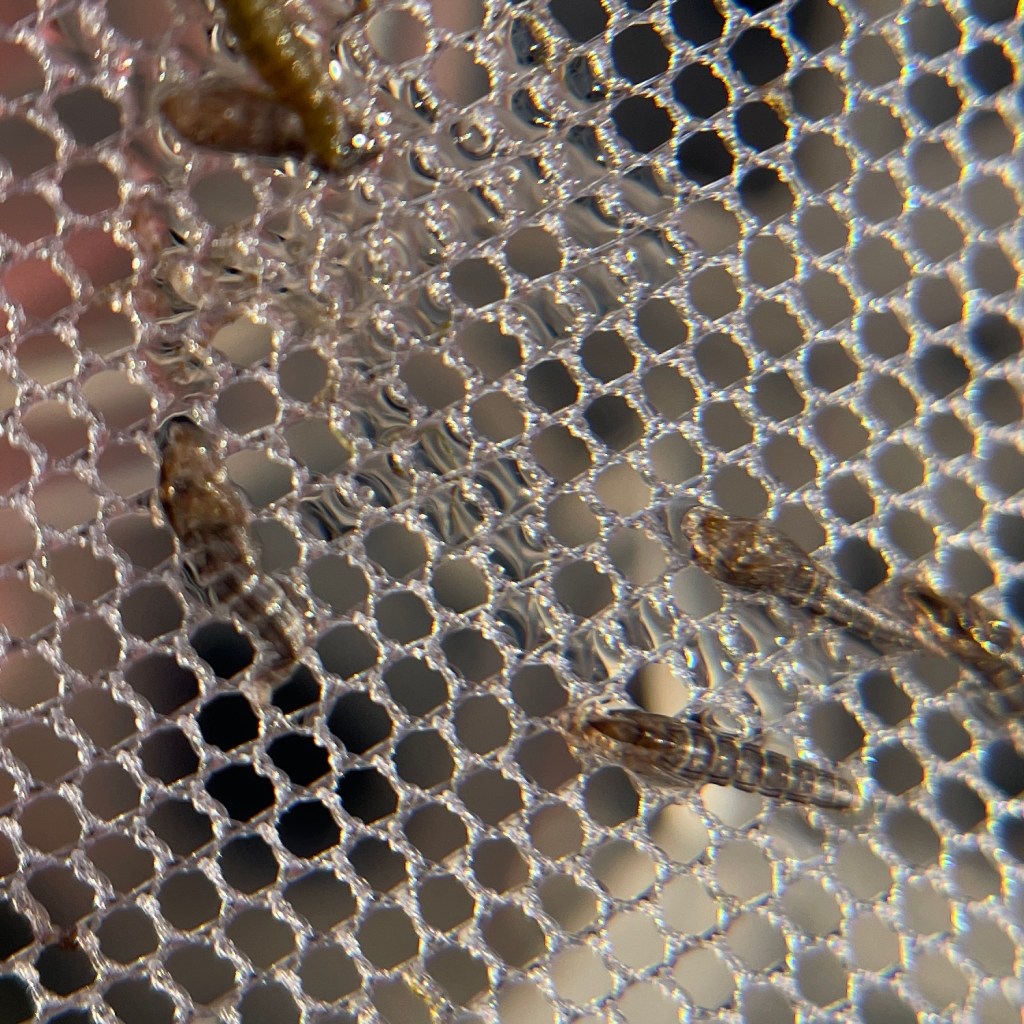
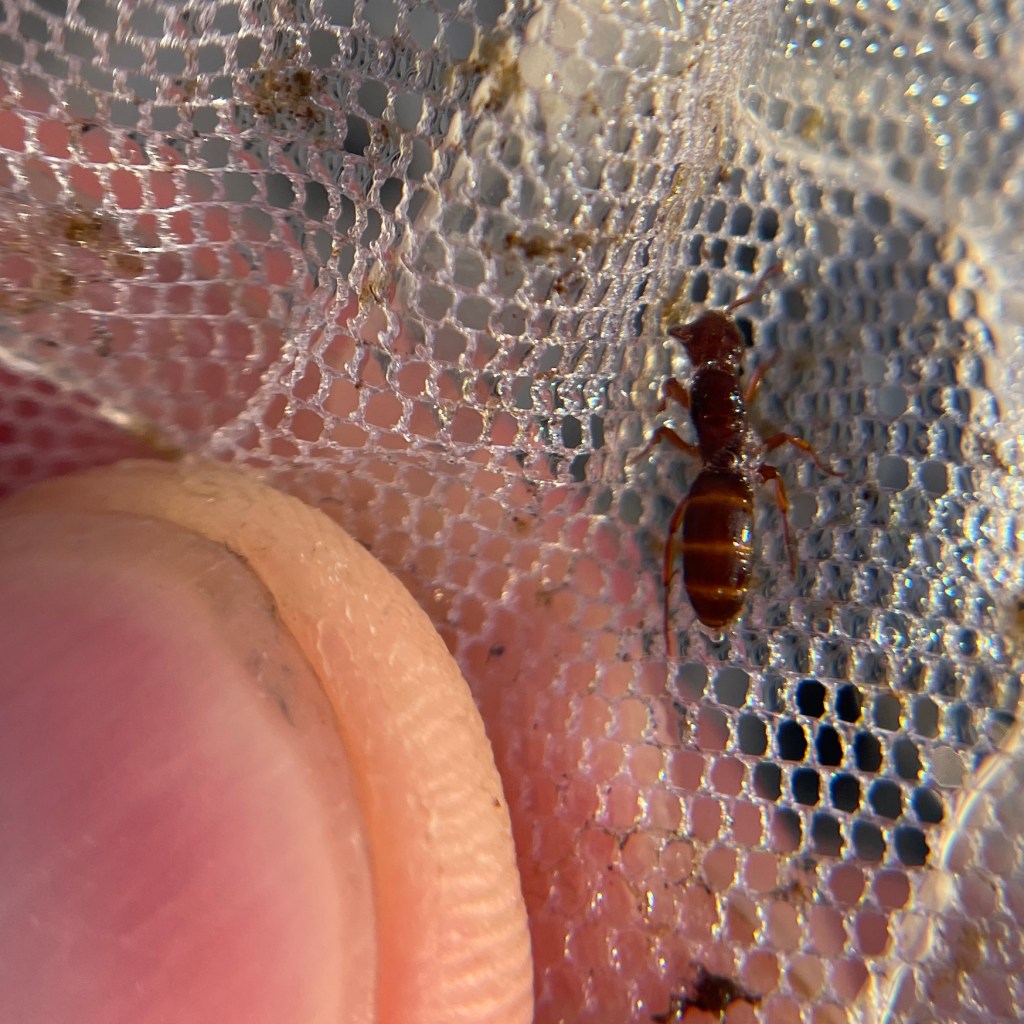
A little over a month ago, I was on a favorite local-ish river and took some time to seine for insects to get a better idea of what the fish had on offer. Midge larvae, ants and mayfly nymphs were the overwhelming food items in the drift.

It was raining heavily (all day) and I seined for quite a while as I was hoping to find larger bugs, but after about 45 minutes in multiple types of water, I was fairly well convinced that this was representative of that section of stream – at that time. Since then, I’ve been using the photos as a reference matching these sizes/profiles/colors for the nymphs I tie with that piece of water in mind.

I noticed the olive midges had white gills, while the grey-ish midges rocked brown gill tufts. I have ideas for adding gills down the line, but for the short term, immediately tied up about a dozen and a half #20 and #22 weighted midges. I settled on a pearl-tinsel undercoat, followed with almost-touching wraps of dun, brown or olive peacock quills for the body. Coating thinly with resin, they looked great and have since produced well.

I note that a day later I looked at them again though and realized all I really did was make tail-free Perdigons. (That didn’t occur to me at all while I was making them)

Heading back to the same stream tomorrow, I wanted to bring something to mimic the mayfly larvae — and and am eager to put them to the test.

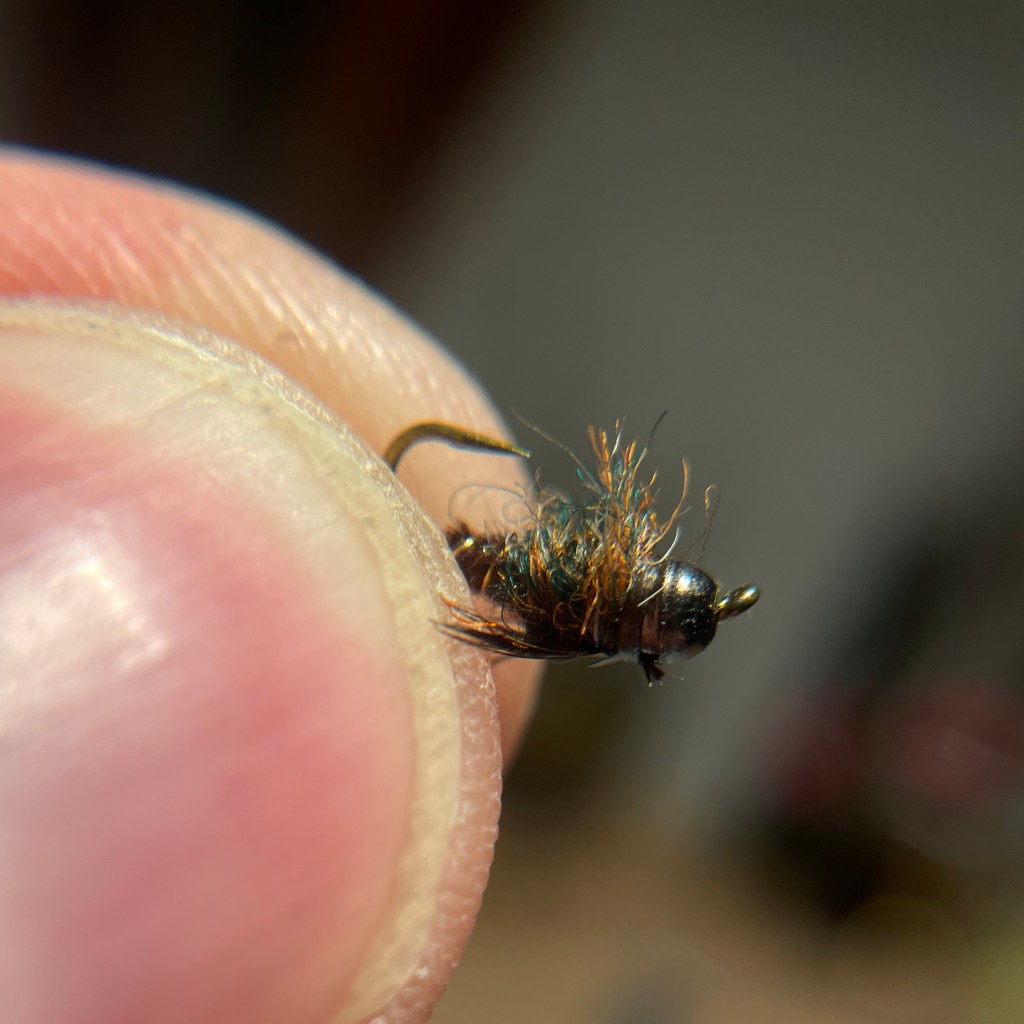
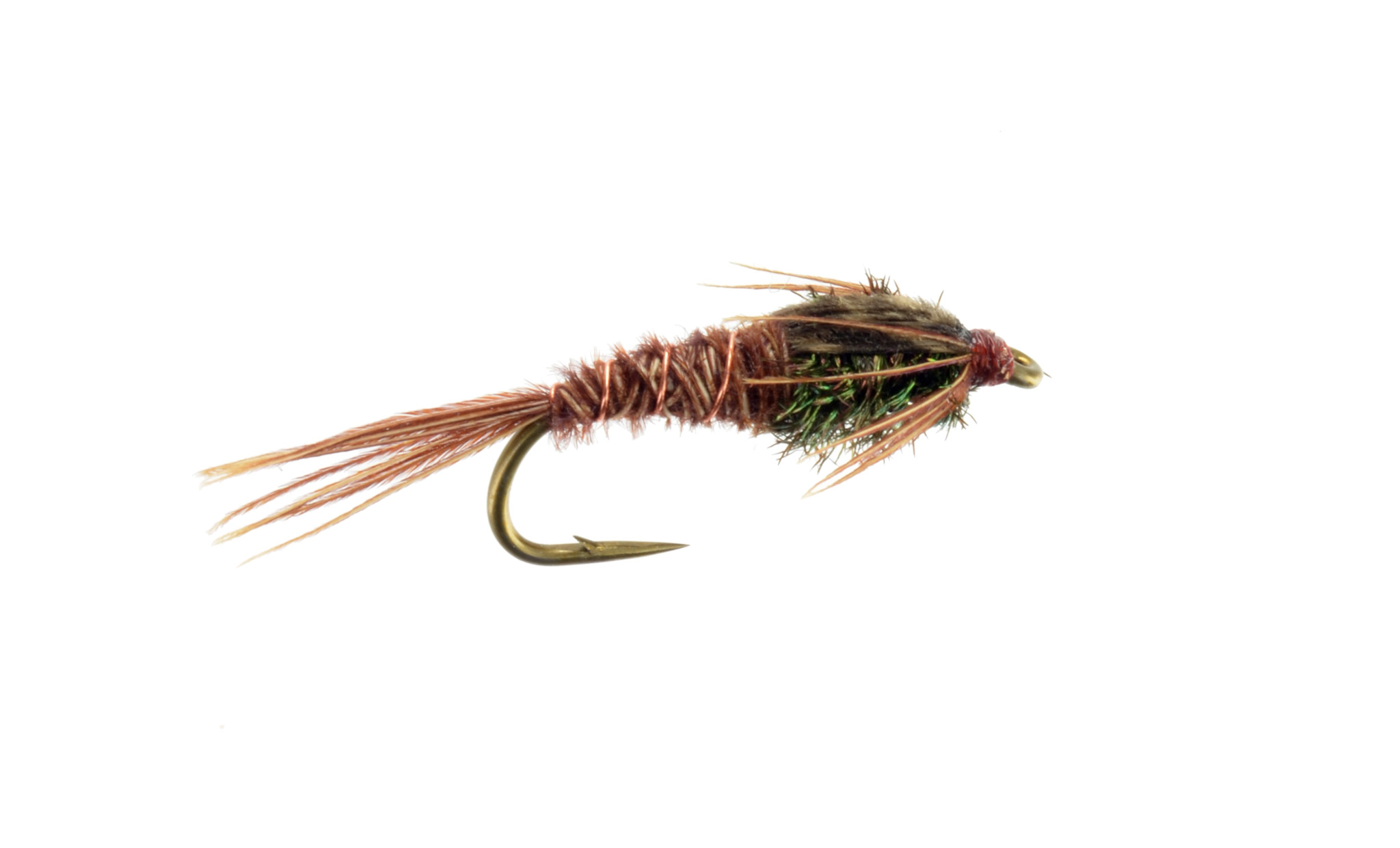
Recipe: Hook: Size 18 nymph hook: 2X long, 2X heavy; Weight: 2.5mm black tungsten bead; Thread: Semperfli’s 12/0 Classic waxed; Tailing: Hen hackle or Partridge; Abdomen: natural or/and orange pheasant tail; Ribbing: gold UTC wire; Thorax: Semperfli’s Dirty Bug Yarn in Mottled Olive; Wingcase: Large HoloTinsel (black).

These were my first flies using the ‘FFF’ Anchor beads. At their price point, I was worried about the quality, but they’re straight-up good. Because I was building in legs into this pattern, I wanted to avoid spiky dubbings for the thorax; I tried Semperfli’s ‘bug yarn’ instead. It provided consistency, but at the cost of versatility (there are two strands to the yarn, so it either goes on at the diameter it comes off the spool – or at 1/2 of that by unwinding it). Because of that it doesn’t end up looking good at all when you wrap it over itself – you can’t seamlessly ‘build up’ and shape with it like you can with dubbing material.

The ‘Mottled Olive’ yarn’s peacock & auburn fibers (shown above) are mottled enough to make me think it has hope (if not promise!) as a material, but next time I’ll probably just dub the thorax like a normal person.


Our seeds finally arrived this week. I have potted up one of our starter pallets and watered in the soil, but still have yet to place the seeds. I need to do that soon, but procrastination is a hell of a drug. Also, the grass is looking pretty green and we don’t have a lawnmower yet — or a shed to put it in. Decent problems to have all-in-all.


Also – this week I learned of Jason Randall who was a guest on The Orvis Flyfishing Podcast:

Jason is a Veterinarian by trade and a scientist at his core who has written several books related to Flyfishing for trout, specifically. His approach to understanding the interplay of physics and biology within stream ecology are quite singular. I was so impressed by his interview with Tom Rosenbauer that I found five other podcast interviews, listened to them in full, and then bought two of his books.

If so inclined, you can hear him at the link above, or here, here, here, here or here.


currently reading: Nymph Masters: Fly-Fishing Secrets from Expert Anglers, Jason Randall

Last full listen: Dark Side of the Moon by Pink Floyd

Forsythias in full bloom; Stoneflies are hatching

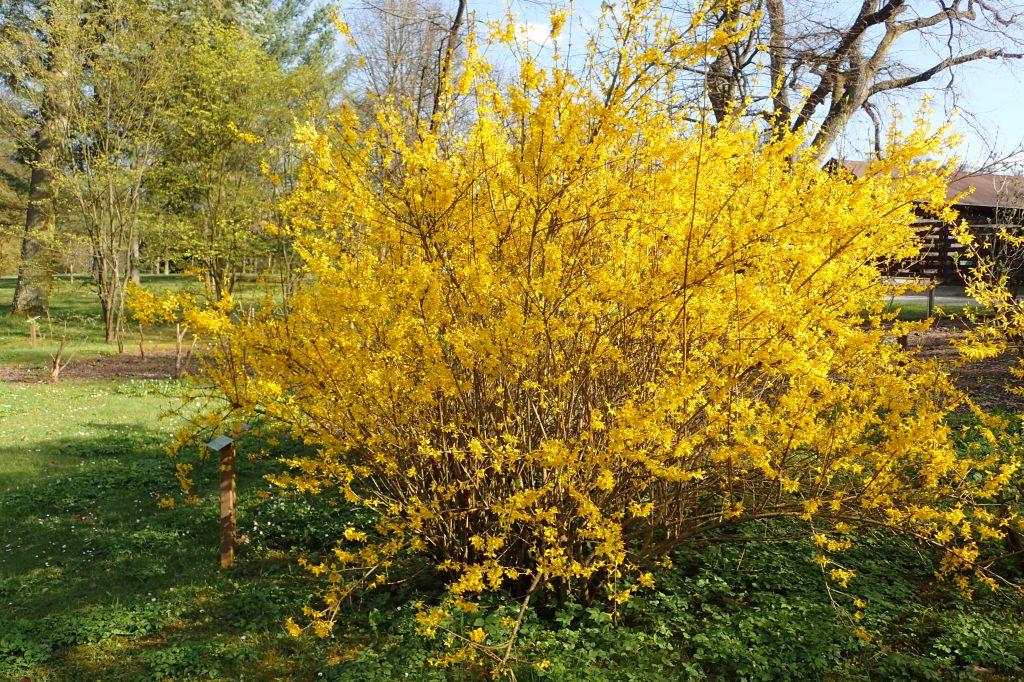
All week I have walked around eying the Forsythia that is fairly popular in landscaping of my neighborhood. It came into full bloom this week with millions of diminutive yellow flowers threatening eventually carpet lawns across the area.

Photo of Forythia by: Krzysztof Ziarnek, Kenraiz, CC BY-SA 4.0, via Wikimedia Commons

On the Gunpowder this weekend, water temperatures were breaking into the 50′ F range by 11am and there was a simultaneous midge and stonefly hatch starting at about 1 pm. I started the day early though and left around 2pm with one fish shy of 10 on the day. I wanted double-digits but that stretch of river was getting crowded. I’ll have to fish faster next time.*

I should look into stonefly patterns at some point. These were almost as long as my thumbnail, with a black skinny body and light dun downwings. Interesting to observe that in flight their body-length wings make them appear relatively large, while at rest they become quite slender. None were spotted on the water’s surface — but I wasn’t seriously looking.

Today (Sunday) I installed screens in all but two of the house windows. SEEB had to hold the ladder on a few climbs as the house has inclines on all sides and our ladder doesn’t have extendable feet for non-level surfaces. It is nice, particular on the second floor, to have the windows open and a nice breeze blowing through.

Tying notes: I tied up a handful of heavier nymph patterns this afternoon (Pheasant Tail bodies on size 14 jigs w/ CDC & black squirrel collars) using 3.8mm tungsten beads. Threw in a few Perdigons on 3.2mm beads. The heavier weights will come in handy when flows in the GP get higher. Tonight, I returned to struggle with Sparkleduns. After tying midges the last couple of months on Veevus 14|0 and 18|0 thread, dialing in the amount of torque to use when cinching down deer hair wings (on 6|0 Danville and 8|0 Uni-thread) snapped a lot of thread ruining a good deal of work. Mid-week last week I tried to tie up a half dozen and failed spectacularly, not able to get a single fly to my liking. I believe I started w/ Nanosilk 30D then, but the GSP kept slicing the deer hair. Moved to wider non-gel-spun threads, but again with the snapping. I tied up Comparaduns last year, and didn’t remember having so much trouble — hoping these notes come in handy in years to come.

Lesson tonight: tying in the wing first is probably best. If the thread snaps while cinching the hair down, you’ve saved time by not tying in the shuck and starting the underbody first. SemperFly NanoSilk 50D worked well tonight (w/ wax applied). Splitting the wings at some point would be interesting, as would mixing in some sighter material in the wings — at least w/ this dark dun-wing pattern I am tying. The Varner short-fine (dun) hair that I was so stoked about actually doesn’t work that as well as I was hoping. Not to say that it can’t, but it is so short that getting enough of it into a mid-sized stacker is a bit of a work-up. The fineness of the hair is amazing though – best I’ve seen tbh – so I may figure something out yet. On a lark, I used the shittiest ‘compardun hair’ I have (from Hareline) and made it work. I now have a whopping two dun-wing sparkleduns now for my efforts. If they catch a fish one day, I hope I remember that those were the two flies that were such a pain in the ass on a random Sunday evening in March of 2024.


currently reading: FilterWorld: How Algorithms Flattened Culture, Kyle Chayka
last full listen: Long Time Coming by Sierra Ferrell

Casting Church

a short video featuring TPFR & the Potomac River

Tidal Potomac Fly Rodders, a charter branch of Fly Fishers International, holds monthly casting clinics in Georgetown (D.C.) on the second Sunday of each month. I have known of this for well over a year; until today I had been to exactly zero of these. I went to Church this past Sunday morning, and found it exceedingly useful. Getting feedback from a certified casting instructor, who could observe from a neutral position, and tell me exactly what they were seeing with my mechanics was pretty awesome.

Noting here that the Potomac was browned out with the recent rains, running muddy as hell and tons of woody debris in the currents. Stream guage at the Little Falls Pump Station marked it at 5.6ft and it has risen all day. I would speculate 4.5ft as the maximum viable wading conditions on the river.

The (last?) winter fishing day of the season

Buds are forming on all the trees, the clock rolls forward an hour tonight, and I expect that with the possible exception of a slight frost between now and April, winter is behind us. Spent the afternoon on a favored MD stream, fishing with a fiberglass rod that is probably my favorite rod to cast tiny dry flies with. I did not plan on casting tiny dry flies though.

Conditions were rainy and colder (high of 44’F), rained all last night and then continued all day long — quite heavily at many points. Water stayed clean though – no brown-outs although the stream banks were fairly treacherous and with that slick red Maryland clay providing some slip & slide moments throughout the day. Browns were taking pheasant tail nymphs (and only PTs) in a size 18 or 20.

I hadn’t used New Zealand indicators in a while — maybe two years ago back in CA, and wanted to spend the day working with those again. They were always lovely in theory, but I never really set them up right on those California rivers. I was playing around with them this week and realized that the amount of wool one uses has to be just so — and back then I was either using too little or too much, trying to learn it in-the-current, to no avail. I have a much higher esteem of them now as an indicator, although I am probably more sour on indicator fishing as a whole, reminded of the lack of connection. At one point today I tried lifting the line and casting upsteam again and after three attempts couldn’t figure out why my line wasn’t getting back upstream, and it turned out I had a fish on the line, a couple of feet below the indicator. Couldn’t feel him at all. It was a beautiful little brown trout, had just traded his juvenile stripes for the purple and pink spots of adolescence, but without a tight connection between my rod tip and the hook, he was imperceptible to the hand. I do honestly get tired of tight-line nymphing all the time though so it is good to have that arrow in the quiver.

Because anglers tend to exaggerate, I am often surprised when something happens exactly as people describe it — I probably dismiss much of the superlative as hyperbole. I believe I heard Tom Rosenbauer once say “if you treat the New Zealand wool with some floatant it’ll float all day long.” Well, turns out that is true. All. Day. Long. Even in the rain. I remember the phrase, but never took it literally. My mistake.

There was a modest but unmistakable hatch all day of size 22/24 white wing midges (I think) but I couldn’t spot any rises or surface takes in the rainy conditions and trying to catch one of the flies for examination didn’t seem worth the effort. I did not seine the water, as I had done that two weeks ago, and did not expect much difference. Water temperatures were 43′-44’F on the day — same as the air — and I am curious as to whether than encourages a midge hatch. For Mayflies and Caddis species, I would expect that warmer air helps them dry off their new wings as they emerge, but it may be the case that Diptera has evolved with less reliance on warmer air at emergence due to their wings having less surface area. Rainy days bring less bird and other activity from avian predators, and so maybe there is a trigger there for the little guys to ditch their nymphal stage and take flight.

Finally – one last thing on the fishing in heavy rain: I now have four boxes (and hundreds of flies) drying out under a circulating fan to avoid any rusting of hooks or matting of materials in soggy boxes ahead of the next outing. I am used to caring for the handful of flies that get lightly used after a day on the water, but when one opens a box to switch out flies in a deluge, no matter how much care is taken, a fair bit of water gets in and all of the flies get wet. Future days of foul-weather fishing may call for more a more pared-back selection carried in a single box.


We are still waiting for our seeds from Southern Exposure Seed Exchange to arrive in the mail. The inaugural garden at the new house will consist of:

  • 4 species of tomatoes (we want to learn canning this year)
  • French Marigolds (for the pollinators during the season, and to control nematodes thereafter)
  • Fava beans (because hell yeah)
  • Kebarika bush beans (for drying)
  • Red Hardneck Garlic
  • Dyer’s Correopsis (because they look cool, and who knows – maybe we’ll dye something)

There will be other items, likely, but this is a start. SEEB also has watercress seeds coming but for obvious reasons they will not be in the garden. We have deep window wells in many spots in the house though and with a few glass containers, we could likely grow a fair amount. Also, if we get some oak casks for rain barrels, they could be used in there.

There was one species of tomato that I missed out on, as I delayed the order and it was no longer in stock: Aunt Lou’s Underground Railroad Tomato: The story is that the seeds were brought up from a black man escaping slavery in Kentucky and given to someone named Aunt Lou as he entered the free states in Ripley, Ohio. The plants are still in cultivar today, but you won’t find them in gardening shops and they aren’t Burpee branded Home Depot tomatoes. I dig the story though – there are skeptics on the veracity of it — but the idea of growing those seemed really cool to me. Seems like something that people should keep growing, even if only to consider the fact that it could have happened.


Thus far, the bird species we’ve seen in the yard are: Morning Doves, Cardinals, Mockingbirds, Sparrows, Starlings, Robins, Woodpeckers, and a pair of Blue Jays. Sarah has seen Kingfishers down on the Turkey Branch of Rock Creek — which until today I had misunderstood as Sligo Creek. Crows and Peregrine Falcons are not far off, but I have not seen them in the yard just yet. The bird feeders and bird baths are drawing tons of early activity to enjoy over coffee in the morning and I expect we’ll see more and more as we convert the front lawn to a more appropriate Chesapeake/Piedmont habitat.


SEEB painted the living room today while I was out fishing. It looks really good. Its a kind of soft yellow — almost a subdued mustard — which I honestly would have never expected to work, but contrasting the white trim of all the baseboards and framing around doors and stairs, ceiling, etc., it makes the whole place come alive in a really warm way. I would have expected it to make the room feel smaller too, but it feels bigger. It was a bold move; it paid off.

Now I am contemplating what color to paint my office.

Modern Ideas in Chess (1923)

Most chess enthusiasts at least know the name, Réti, but until about a month ago, I had no idea this book even existed. As part of a training regimen I was recently given a choice for required reading between two titles, this being one of them. I could not find any used copies of the out of print book online and thus resigned myself to studying the other title. Then last week, on a shelf at Second Story Books in Rockville, Maryland, sat a perfect, unread copy of a 1960 printing from Dover Publications. The first I’d ever seen.

The listed price was $6, and all books there are 50% off the listed price. I have been reading this at the dog park over the last week, with some stints here at the house. It is a quick read, but one whose benefits, I believe, will linger.

In this book, Reti sets forth on the task of concisely illustrating the preceding hundred years of chess. He begins with Adolph Anderssen (b.1818) who leads into Morphy (b. 1837) and illustrates the ideas and developments of each successive era. That the book itself is written from a vantage already almost a century in the past, reading it was exceptionally insightful and made me–makes me–wonder: What have we forgotten?

I was born in 1974. I grew up post-Bobby Fischer, but in terms of chess culture, the world I knew growing up was one in which the Russians still dominated the game. As far as I knew, it had always been thus. Yet here in 1923, this Austro-Hungarian (later Czech) Master published an entire chapter titled AMERICANISM IN CHESS where he extolled the virtue of American Chess, deeming it superior to that of his native Europe and predicting that the future of chess (and more) belonged to the Americans.

For such is the strength and weakness of the European thinker and plodder, that he always strives after the impossible. The American is steady and turns what is possible to account…

To the European mind has undoubtedly belonged the past; possibly to Americans belong the present and the future.

-Richard Reti, Modern Ideas in Chess

About twenty years ago Garry Kasparov, arguably the strongest player the game of chess had ever seen, was releasing his series of books: My Great Predecessors. In these volumes, he systemically covered chess history in the modern era through the games and lives of past World Champions. The knock on that series–and one that I tend to agree with–is that the content is too intense. Countless side lines and variations and histories of which moves had been played from exact positions all added up to muddled and confusing incomprehensibility that few can cut through. Réti avoids all of that with simplicity and brevity. He provides no more than a single game per each Master mentioned, and the games themselves are only analyzed to the point of illustrating what each successive master brought to the game. He sets out to explain in prose and then support through concise presentation.

Anderssen – and his brilliance in calculating sacrifices and combinations. Morphy–playing the exact same position faced by Anderssen–and declining the immediate combination or attack and opting instead to develop his pieces to positions less favorable in the moment, but exceedingly advantageous within a short series of moves. Steinitz, later facing similar positions to Morphy, but having an approach to placing his pieces in accordance with more static and permanent features of the developing position. On and on for another 160 pages! Tarrasch. Lasker. Pillsbury. Akiba Rubenstein. Capablanca. Alekhine. With mentions and commentary on other notable figures throughout the years: Maroczy, Jaenish, Chigorin, Breyer, Schlechter, and more – namesake discovers of opening variations and positions students of the game study to present day. Réti provides an easily comprehensible context and chronology of them all in this short 180 page work. It is a beautiful thing.

For anyone who is interested in the history of chess or maybe even the history of ideas, this book is a must read. If one considers themselves a student of the game, and particularly if they utilize the study of so-called “Master Games” to improve their play, then this book becomes almost a Rosetta Stone. I have recently been studying Alekhine for example, and had a hard time understanding all but his tactics and endgames; the context Richard Réti provides on the ‘hyper-moderns’ illuminated much for me, by way of example. The book is not for understanding why Akiba Rubenstein –or any other Master — was brilliant in all the ways he was brilliant, but rather to show how each of them fit in the legacy that is the birthright of most anyone alive today.

In short, the book is amazing, and I would argue even more relevant today than when it was published a hundred years ago. If you are remotely interested in the book, obtain a copy and give it a shot. You will be glad you did.